SESSION NOTE 03 / REVERB
Reverb Pre-Delay & BPM: Timing Chart and Practical Setup
Use short note lengths as pre-delay references, while keeping the reverb’s onset and decay separate.
THE SHORT ANSWER
Pre-delay controls the gap before reverberation begins; decay controls how it fades. BPM can give you reference intervals for that gap. At 120 BPM, a straight 1/64 note is 31.25 ms and a 1/32 note is 62.5 ms. Neither is a universal best setting.
Try 120 BPM · 31.25 ms pre-delay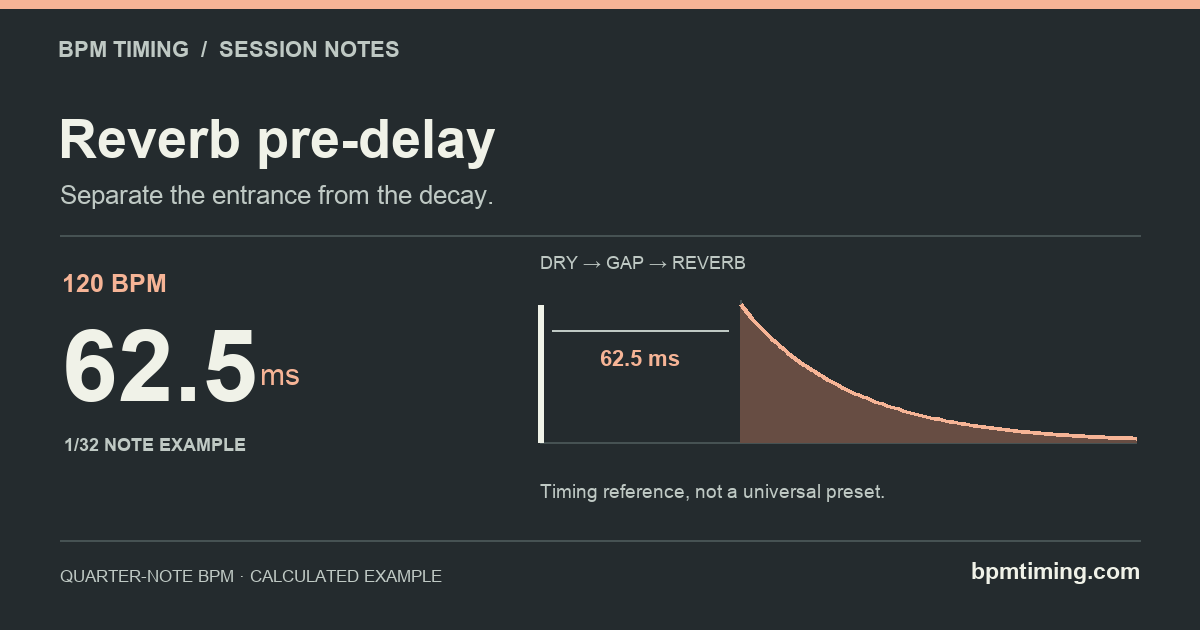
Pre-delay and decay do different jobs
A dry note starts, a gap passes, and then the reverb arrives and fades. Changing the gap moves the reverb’s entrance relative to the dry sound. Changing decay changes the length of its fading tail. The controls interact musically, but they are not interchangeable.
Signal sequence only · not to scale · not a measured waveform
Yamaha’s reverb guide describes pre-delay as a delay before the reverb and discusses checking whether a tail overlaps the next phrase. It also explains that a large pre-delay can become an audible separation. That makes listening in the arrangement essential.
Use BPM as a reference, not a prescription
With quarter-note BPM, a straight note’s duration is (60,000 ÷ BPM) × (4 ÷ denominator). Short note values give a small set of comparable intervals. Choose one to audition, then adjust it for the source and the effect you want.
Swipe the table to compare all columns.
| Tempo | 1/64 note | 1/32 note | 1/16 note |
|---|---|---|---|
| 80 BPM | 46.875 | 93.75 | 187.5 |
| 100 BPM | 37.5 | 75 | 150 |
| 120 BPM | 31.25 | 62.5 | 125 |
| 128 BPM | 29.297 | 58.594 | 117.188 |
| 140 BPM | 26.786 | 53.571 | 107.143 |
At 120 BPM, compare 31.25 ms and 62.5 ms. If the longer setting sounds like the room arrives separately from the note, try the shorter setting or a value between them. A rhythmic onset can be a deliberate effect, but it is not required for every reverb.
The 1/16 column shows how quickly a musical fraction can become a substantial gap: 125 ms at 120 BPM. These columns are calculated durations, not measured ideal settings for vocals, drums or rooms. The same BPM can support very different phrases and arrangements.
Open 128 BPM · 1/32 noteA focused comparison in your DAW
- Loop a representative phrase. Include its attack and the space before the next phrase. Keep the reverb type, decay and wet level fixed for this comparison.
- Compare two onset times. For the 120 BPM example, enter 31.25 ms, then 62.5 ms. If your plug-in rounds to whole milliseconds, use 31 and 63 ms and treat them as approximations.
- Return to the full mix. Decide whether the entrance leaves the phrase clear or sounds detached. Try an intermediate or unsynced value if both note lengths miss the effect you want.
- Adjust decay separately. If the entrance works but the tail fills the next phrase, compare a shorter decay while keeping pre-delay fixed. Do not assume increasing pre-delay will shorten the tail.
This is a repeatable listening procedure, not a preset recommendation or a report of a listening test. If the project tempo changes, a fixed millisecond setting stays fixed. Whether that is desirable depends on the arrangement; use the plug-in’s documented tempo-sync mode when you want it to follow tempo.
What the calculation cannot tell you
- Does the tail need to end exactly on a beat?
- No. A note duration can be a comparison point, but BPM alone does not determine a useful decay time. Judge the tail against the actual gaps and overlapping sounds.
- Can I subtract pre-delay from one bar to get the perfect decay?
- That subtraction only divides a time interval. It does not model a reverb envelope or ensure that its sound ends at the bar line. Decay controls and early reflections depend on the algorithm.
- Does this calculate a room’s RT60?
- No. These values come from tempo and note ratios. They contain no measurements of a room, its surfaces or its acoustic response.
- What if my reverb has no millisecond readout?
- Use the calculated interval as context, then check the device documentation. An arbitrary knob position cannot be converted reliably without knowing its scale.
For discrete repeating echoes, read the dotted eighth delay guide. For a modulation rate rather than an onset gap, use the LFO timing guide. The method page lists the calculator’s shared assumptions and limits.
Sources & calculation notes
Sources checked October 31, 2026. Numerical tables use the formulas and precision described in our method, using the same math as the calculator. Device references describe documented behavior; they are not claims of hands-on testing or affiliation.