SESSION NOTE 05 / LOOPS
Bars to Seconds: BPM Formula, Loop Lengths & Time Signatures
Work out the duration of an intro, loop or export range without confusing a bar with a whole note.
THE SHORT ANSWER
In 4/4, seconds = bars × 240 ÷ quarter-note BPM. At 120 BPM, 8 bars last 16 seconds. For a time signature N/D, use bars × N × (4 ÷ D) × 60 ÷ BPM. The tempo must refer to quarter notes.
Check a 120 BPM quarter · 500 ms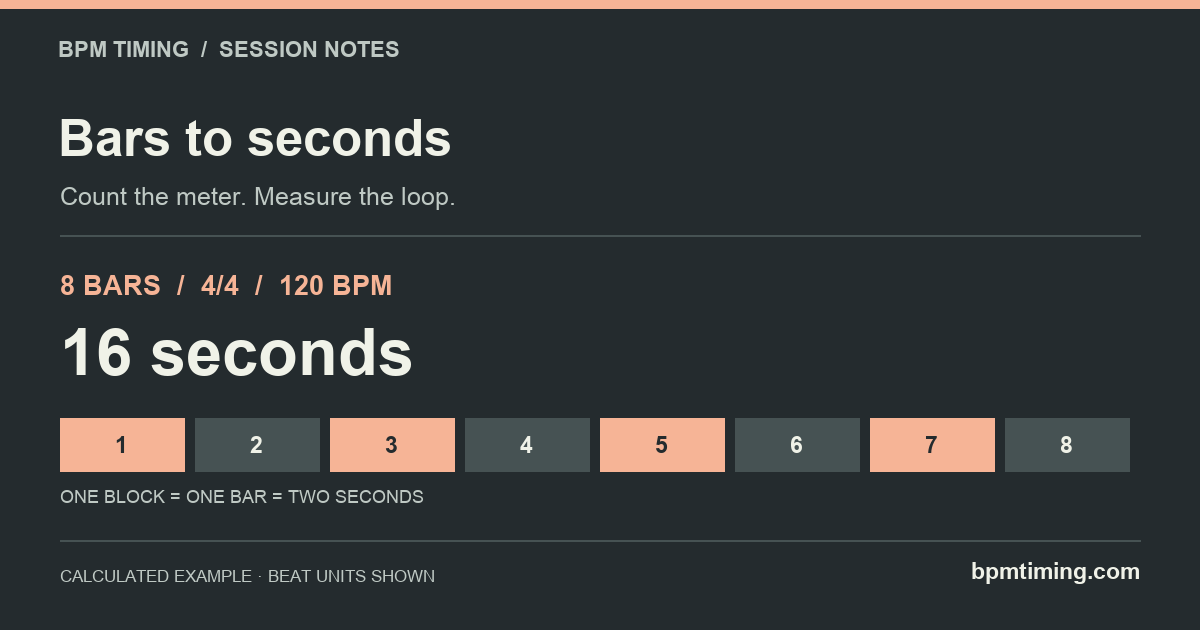
Count quarter notes per bar first
A bar has no fixed length in seconds. At a constant tempo, its duration depends on how much musical time the meter puts inside it. In a time signature N/D, each bar contains N notes of length 1/D. That gives N × 4/D quarter notes per bar.
Loop seconds = bars × seconds per bar
Bars = seconds × BPM ÷ (60 × N × 4/D)
For 4/4 at 120 BPM, one quarter lasts 0.5 seconds, one bar lasts 2 seconds, and eight bars last 16 seconds. For 3/4 at the same quarter-note tempo, one bar lasts 1.5 seconds and eight bars last 12 seconds. A whole note still lasts 2 seconds in both examples.
The calculator's whole-note row is therefore a one-bar reference only when the bar contains four quarter notes, as in 4/4. It is not a meter selector. For other meters, use the quarter-note result and multiply by the quarter-note count per bar.
Quick chart for 4/4 loops
Swipe the table to compare all columns.
| Quarter-note BPM | 1 bar | 4 bars | 8 bars | 16 bars |
|---|---|---|---|---|
| 80 | 3 | 12 | 24 | 48 |
| 90 | 2.667 | 10.667 | 21.333 | 42.667 |
| 100 | 2.4 | 9.6 | 19.2 | 38.4 |
| 120 | 2 | 8 | 16 | 32 |
| 128 | 1.875 | 7.5 | 15 | 30 |
| 140 | 1.714 | 6.857 | 13.714 | 27.429 |
| 160 | 1.5 | 6 | 12 | 24 |
At 128 BPM, one 4/4 bar is 1.875 seconds. A four-bar loop lasts 7.5 seconds, an eight-bar loop 15 seconds and a sixteen-bar section 30 seconds. These are range lengths at a fixed tempo, excluding pre-roll and any effect tail added after the end.
Count intervals between bar lines. A range from the start of bar 1 to the start of bar 9 contains eight complete bars. The two labels differ by eight; counting both boundary labels as bars would add a bar that is not in the range.
Check 128 BPM · whole note = one 4/4 bar3/4, 6/8 and the meaning of BPM
Swipe the table to compare all columns.
| Meter | Quarter notes per bar | Seconds per bar |
|---|---|---|
| 3/4 | 3 | 1.5 |
| 4/4 | 4 | 2 |
| 6/8 | 3 | 1.5 |
| 7/8 | 3.5 | 1.75 |
3/4 and 6/8 have the same written duration per bar when the quarter-note BPM is held fixed. They do not have the same grouping or musical feel. The timing calculation does not attempt to describe those accents.
If a 6/8 tempo marking says dotted quarter = 80, first convert it to quarter = 120. The bar then lasts 1.5 seconds. You can cross-check using two dotted-quarter pulses per bar: 2 × 60/80 = 1.5 seconds. See the 6/8 tempo guide for the full conversion and delay settings.
A label saying only “80 BPM in 6/8” is missing the beat unit. It could describe dotted-quarter pulses or a DAW's quarter-note tempo. Confirm the convention before trimming a loop.
Check exports, samples and tempo changes
To turn a duration into a sample-frame count, multiply seconds by the sample rate in hertz. At 48,000 Hz, the eight-bar, 128 BPM example occupies 15 × 48,000 = 720,000 sample frames. Stereo has two channel values per frame, but the duration is still 720,000 frames; do not double it to calculate time.
Some tempo and sample-rate combinations give fractional frame counts. At 123 BPM, one 4/4 bar is 240/123 seconds; at 44,100 Hz that is approximately 86,048.780 frames. An actual boundary must land on a whole frame. Calculate the complete range and round once at its boundary, rather than rounding a single bar and multiplying the error across many bars.
For a tempo change at a bar boundary, calculate each constant-tempo section and add its duration. Four 4/4 bars at 120 BPM take 8 seconds; four more at 100 BPM take 9.6 seconds, for a total of 17.6 seconds. A single average of 120 and 100 does not give the same result.
For a continuous tempo ramp, use your DAW's time ruler for the selected range. Ableton's Arrangement View documentation describes its musical and absolute time rulers and tempo editing. A fixed-BPM formula does not model a ramp. Verify the rendered file's length if you add a tail, count-in or pre-roll.
Sources & calculation notes
- Open Music Theory: meter and time signatures
- Ableton Live 12: Arrangement View, time rulers and tempo changes
Sources checked November 1, 2026. Bar lengths are derived here from quarter-note BPM and the stated meter. Sample counts are duration × sample rate; examples are arithmetic, not measurements of a DAW export. Device references describe documented behavior; they are not claims of hands-on testing or affiliation.